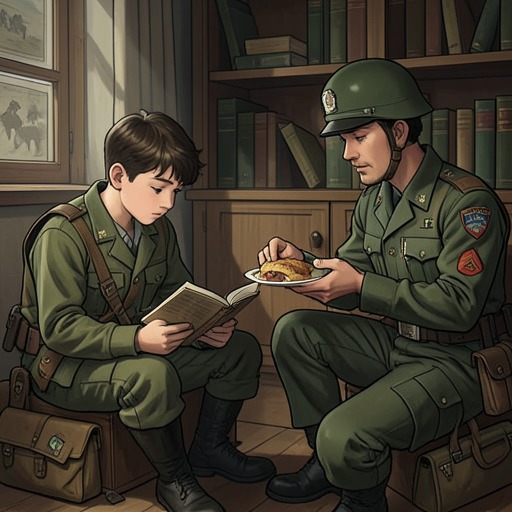
The Narrator and Gavrila: Care and Mentorship
The Painted BirdThe relationship between The narrator and Red Army mentor Gavrila joins the practical work of wartime care to a fragile promise of belonging. Gavrila helps prepare the boy for life after the army: he secures his papers, gives him books, urges him to keep learning, and offers to take him in if his family cannot be found. The separation is therefore both necessary and provisional. The narrator is sent onward under official rules, yet imagines that Gavrila might still become the adult who chooses him as family.
Care at the End of the War
As the war approaches its end, Gavrila explains that the country has been liberated from the Germans and that regulations require lost children to be taken to special centers while officials determine whether their parents are alive. The narrator struggles to accept that he must leave Gavrila, Red Army sniper Mitka, and the other soldiers who have become his friends. He watches Gavrila’s face and holds back tears; he senses that Gavrila is uneasy too. Gavrila and Mitka have discussed what should happen to him, and the narrator believes they would have found another solution if one had been possible.
The official arrangement does not erase the personal attachment. Gavrila promises that, if no relatives claim the boy within three months after the war ends, he will care for him himself. He will send the narrator to a school where he can be taught to speak again. The promise makes care concrete: it offers a home, schooling, and a response to the boy’s difficulty speaking, rather than merely comfort at the moment of parting. At the same time, its condition leaves the future unsettled. The boy must first be separated from Gavrila and wait to learn whether his family can be recovered.
Preparing the Boy to Leave
Gavrila’s mentorship is expressed through practical preparation as much as affection. He makes sure the boy has all his belongings and that his personal file is in order. The file gathers the information the narrator has supplied about his name, former residence, parents, hometown, relatives, and friends. In preserving these fragments, Gavrila helps turn a child’s partial memories into information that might make family identification possible.
He also gives the boy books and urges him to remember what he has learned and to read Pravda every day. The advice points toward education and continued engagement with the world beyond the regiment. The narrator receives a bag of gifts from the soldiers and wears a Soviet Army uniform specially made for him by the regimental tailor. In its pocket is a small wooden pistol bearing pictures of Stalin and Lenin. The objects make the departure feel like a carefully marked transition: the boy leaves with a record of his past, gifts from the people he is leaving, and the clothing of the army that has sheltered him.
At the final parting, Mitka pats the narrator’s shoulder and urges him to uphold the Red Army’s honor. Gavrila hugs him warmly; the other soldiers shake his hand as though he were grown. The narrator wants to cry but keeps his face composed, adopting the self-control of a soldier as he is driven to the station with Sergeant Yury. The farewell is not a casual dispersal. It gives the boy recognition and affection at the same moment that military and postwar procedures carry him away from the people who have provided them.
The Promise as an Alternative Family
The conditional offer to adopt the narrator acquires greater weight after he reaches his birth parents. Although they have found him and welcome him into their apartment, he doubts whether returning to family life is what he wants. Their home is small and crowded, and daily life there feels predictable to him. He considers whether it would be better to remain on his own and wait for Gavrila, who might eventually adopt him. The thought reveals that the promise has become more than a reassurance about what might happen if the search for relatives fails: it is a future the narrator actively prefers, at least in this moment, to the safety and routine of reunion.
His longing is not simply a rejection of his parents. It grows out of the contrast between the known bond with Gavrila and the strangeness of a family life resumed after prolonged separation. The narrator has already learned to imagine himself moving from place to place without stable protection. Gavrila’s offer gives that unsettled existence an imaginable destination: a guardian who knows him, a school, and a chance to learn to speak. Yet the plan depends on circumstances outside either character’s control. The narrator has been sent to the center precisely so that officials can establish whether his relatives are alive, and his reunion makes the adoption promise conditional rather than certain.
Separation and the Bond’s Afterlife
After the narrator returns to his parents, the war ends in May. He visits the orphanage repeatedly, hoping for a letter from Gavrila or Mitka, but finds none. His reading of the newspapers suggests that the soldiers will not return soon because armies remain abroad and Germany is to be occupied. The promised possibility of reunion therefore remains suspended: the narrator has no news that Gavrila has come for him, and the separation becomes part of the unsettled postwar life around him.
Later, at a mountain shelter, the narrator watches an older ski instructor kneel to pray and reflects that each person stands alone. In this bleak reckoning, he names Gavrila, Mitka, and the Silent One as people who are expendable. The thought does not cancel the earlier care or the narrator’s wish that Gavrila might adopt him. Instead, it exposes the cost of attachment in a life shaped by repeated separation: the boy who once held on to the prospect of a chosen family now treats even the people who mattered most as unable to guarantee lasting protection. Gavrila’s place in the narrator’s memory thus holds two truths together: he was a caring mentor who offered a possible home, and he belongs to a world in which closeness cannot promise permanence.